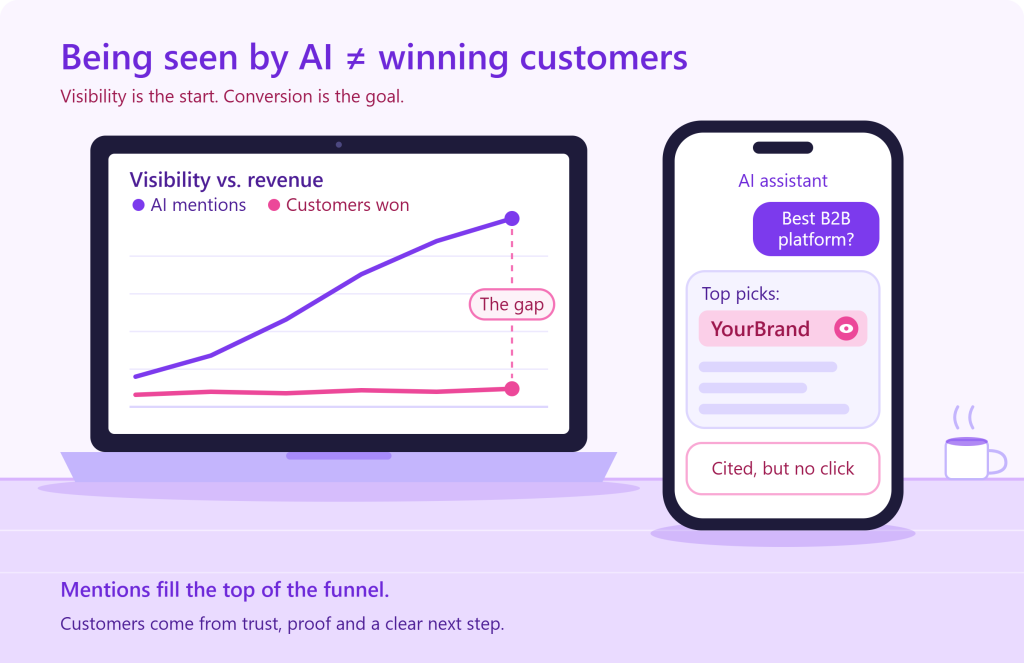
Why Being Seen by AI Is Not the Same as Winning Customers
Visibility and Traffic Are No Longer the Same Thing
For years, digital marketing teams have measured search success through familiar metrics: keyword rankings, impressions, clicks, organic sessions, and conversions.
But search is changing.
People increasingly use AI-powered search experiences to research products, compare suppliers, understand technical subjects, and find recommendations. These systems can provide answers directly, sometimes without requiring users to visit the websites that supplied the information.
This creates an important distinction:
A brand can become more visible in search while receiving fewer website visits.
The distinction matters particularly for B2B businesses, manufacturers, professional service providers, and international companies that depend on organic search to attract new customers.
The challenge for marketers is no longer simply to rank higher. It is to make the brand discoverable, credible, memorable, and commercially relevant—even when the customer does not immediately click.
1. Understand the Difference Between AI Visibility and Website Traffic
A recent development illustrates this challenge.
In October 2026, Reddit CEO Steve Huffman said Google search referrals to the platform had declined by more than one million per week on average during October. He attributed part of the problem to AI-powered search experiences that answer users’ questions without sending them to external websites.
This is an important case study, although one company’s experience should not be treated as a universal measurement of the entire internet.
At the same time, Google announced changes to AI Overviews and AI Mode on October 15. These include showing inline links higher in responses more frequently, making related links more prominent, and testing dedicated sections for official websites when users need to complete specific tasks.
Together, these developments reveal an important tension: AI search can satisfy users without a click, but search platforms are also experimenting with ways to help users discover original sources.
For marketers, this means measuring two separate outcomes:
– Visibility: Does the brand appear in relevant search results and AI-generated answers?
– Acquisition: Does that visibility produce website visits, inquiries, leads, and customers?
A brand mention is not automatically a referral. A citation is not automatically a conversion.
Understanding the difference is the first step toward building a more realistic search strategy.
2. Do Not Abandon Traditional SEO
The growth of AI search does not mean traditional SEO has become irrelevant.
An April 2026 B2B search benchmark from Octane11 analyzed 25 million website sessions across its ecosystem. Its report found that AI search engines accounted for less than 2% of total B2B search referral traffic during the measured period, while traditional organic search still represented more than 98%.
The report covers September 2025 through March 2026, so its figures should be treated as a specific industry benchmark rather than a universal market statistic.
Nevertheless, the strategic lesson is useful: AI search is an emerging discovery channel, while traditional organic search remains commercially important.
A balanced strategy should therefore invest in three areas:
1. Traditional SEO: Technical performance, search intent, keyword research, useful content, internal linking, and authority.
2. AI search visibility: Clear explanations, original information, credible sources, and content that can be accurately interpreted and referenced.
3. Demand generation: Brand awareness, email marketing, professional networks, partnerships, and direct customer relationships.
The strongest approach is to improve these areas together rather than replacing one with another.
3. Create Content That Deserves to Be Cited
AI tools can generate thousands of articles about almost any subject. This makes generic content increasingly easy to reproduce.
If your website publishes the same information as hundreds of competitors, why should a customer—or an AI system—prefer your content?
The answer is differentiation.
Create resources that contain information your business is particularly well positioned to provide.
For a manufacturer, this might include:
– Technical product specifications and application guides.
– Comparisons between different materials or formulations.
– Case studies based on real customer projects.
– Industry-specific recommendations.
– Quality-control procedures and testing explanations.
– Frequently asked questions from purchasing teams.
For a digital marketing agency, it could include:
– Original campaign performance analyses.
– International market-entry case studies.
– SEO experiments with documented results.
– Industry-specific keyword research.
– Conversion optimization studies.
– Practical comparisons of marketing strategies.
A useful article should answer the reader’s question directly and then provide enough detail to help them understand the subject.
Use descriptive headings, accurate terminology, concise definitions, supporting evidence, and relevant internal links.
Include original data whenever possible. If you publish statistics, explain where they came from, when they were collected, and what they actually measure.
Avoid publishing unsupported claims simply because they sound impressive.
The objective is not to produce more content. It is to publish information that competitors cannot easily reproduce.
4. Turn Your Website Into a Commercial Destination
A website should do more than attract visitors. It should help potential customers make decisions.
Consider a company selling industrial materials to international buyers.

A general article explaining a product category might attract informational traffic, but a buyer evaluating suppliers needs much more:
– Available product grades and specifications.
– Applications and technical characteristics.
– Packaging and minimum order quantities.
– Export markets and delivery capabilities.
– Quality documentation and certifications.
– Commercial terms and purchasing procedures.
– A clear way to request a quotation.
This information makes the website more useful during the buying process.
The same principle applies to professional services. A marketing agency should explain its services, target industries, process, experience, evidence of results, and next steps.
A strong commercial page should answer four questions:
1. What does the company offer?
2. Who is the offer designed for?
3. Why should a customer trust this company?
4. What should the customer do next?
If a visitor discovers your brand through an AI answer but finds an unclear website, the visibility may produce little commercial value.
Make every important landing page a destination worth visiting.
5. Adapt Your International SEO Strategy
International search requires more than translating existing pages.
A customer in Germany, the UAE, South Africa, or Turkey may search for the same product using different terminology, purchasing criteria, and commercial expectations.
Even when two markets share a language, their search behavior can differ.
A strong international SEO strategy should consider:
Local search intent
Research the terms buyers actually use in each market. Direct translations of English keywords are not always the phrases local customers prefer.
Localized commercial information
Include relevant delivery arrangements, currencies, units of measurement, product standards, certifications, and contact details.
Regional credibility
Where applicable, demonstrate local experience through distributors, customers, projects, partnerships, or market-specific documentation.
Technical localization
Use an appropriate URL structure, language targeting, canonical tags, and hreflang annotations where relevant. Ensure that localized pages are accessible to search engines and that each version provides genuine value.
Language quality
Technical and commercial content should be reviewed by people who understand the language and the industry. Incorrect translations of specifications or purchasing conditions can damage customer trust.
The goal is not to create dozens of nearly identical country pages. It is to build useful market-specific experiences that address real customer needs.
6. Build Channels You Can Influence Directly
Search engines and AI platforms are important discovery channels, but businesses should avoid depending entirely on platforms they do not control.
Develop a broader digital marketing ecosystem.
Useful channels include:
– Opt-in email newsletters.
– LinkedIn and other relevant professional networks.
– Industry communities and trade associations.
– YouTube and educational video content.
– Distributor and business-partner networks.
– Webinars, exhibitions, and industry events.
– Customer referral programs.
For B2B businesses, email can be particularly valuable because purchasing decisions often involve several conversations over an extended period.
A useful newsletter might include product updates, technical articles, market information, case studies, or practical industry insights.
Collect email addresses transparently and obtain appropriate consent. Segment subscribers according to their interests and business needs rather than sending identical messages to everyone.
The objective is to build relationships that continue beyond an individual search session.
7. Measure the Entire Customer Journey
Traditional SEO reports are not enough to evaluate the full impact of AI-driven discovery.
Build a measurement framework that separates search visibility, referral traffic, and commercial outcomes.
Measurement area| What to monitor| What it tells you
Organic search| Impressions, clicks, rankings, and landing pages| How customers discover your website
AI visibility| Brand mentions, citations, and recommendation frequency| Whether AI systems recognize your brand
Referral traffic| Visits from identifiable AI platforms| Whether AI discovery produces website visits
Engagement| Relevant page views, returning visitors, and conversions| Whether visitors find your website useful
Lead generation| Qualified inquiries and sales opportunities| Whether marketing attracts potential customers
Revenue| Closed deals and assisted conversions| Whether visibility contributes to business growth
Google Search Console can help monitor organic search performance by query, page, country, and device.
Google Analytics 4 can help identify referral traffic from AI platforms when the referring source is available.
For AI visibility, create a consistent set of relevant questions and test them periodically across major AI search platforms. Record whether your brand appears, whether it is cited, which competitors are recommended, and which sources are referenced.
Do not confuse a brand mention with a website visit. These are different outcomes and should be reported separately.
Connect marketing data with your CRM whenever possible. This makes it easier to understand which channels contribute to qualified leads and actual sales.
8. A Practical 30-Day Action Plan
You do not need to redesign your entire marketing operation to respond to these changes.

Start with a focused 30-day project.
Week 1: Establish Your Baseline
Review your website’s organic performance over the previous 90 days.
Identify:
– Your highest-performing landing pages.
– Important commercial keywords.
– Countries generating relevant traffic.
– Pages with high impressions but weak click-through rates.
– Pages attracting traffic without generating inquiries.
Also prepare a list of 20 important customer questions and test how your brand appears in relevant AI search experiences.
Record the results so you can compare them later.
Week 2: Improve Your Most Important Pages
Select five pages with strong commercial potential.
Improve their content by adding:
– Clear answers to important customer questions.
– Original technical or commercial information.
– Relevant evidence and examples.
– Better headings and internal links.
– Stronger calls to action.
– Accurate, useful metadata.
Review their technical performance and ensure that important content is accessible to search engines.
Week 3: Publish One Original Resource
Create a valuable resource that demonstrates your company’s expertise.
Examples include a detailed industry guide, a technical comparison, an original market analysis, or a documented customer case study.
Distribute it through your website, LinkedIn, email newsletter, and relevant industry channels.
Focus on attracting the right audience rather than maximizing impressions.
Week 4: Evaluate Commercial Performance
Compare the new results with your baseline.
Review organic traffic, identifiable AI referrals, brand visibility, qualified inquiries, and customer engagement.
Ask whether the work has improved discoverability, website usefulness, and lead quality.
Use the findings to determine which pages and channels deserve further investment.